Solving the hardest problem in nutrition
Fitting meals to per-day nutrition targets
For decades, personalised meal planning has been approached in much the same way.
- Start with a database of recipes.
- Filter out the ones that don’t fit.
- Assemble what’s left into a meal plan.
It’s a logical approach—but it’s fundamentally the wrong way to think about the problem.

At first glance, personalised meal planning seems simple.
Set a nutrition target. Recommend a few recipes. Build a meal plan. But that’s not what happens in reality. Every meal changes the nutritional balance of the entire day.
Imagine you’re trying to create a day that delivers:
- 2,000 Calories
- 140g Protein
- 30g Fibre
- Less than 50g Sugar
- Mediterranean style
- Gluten Free
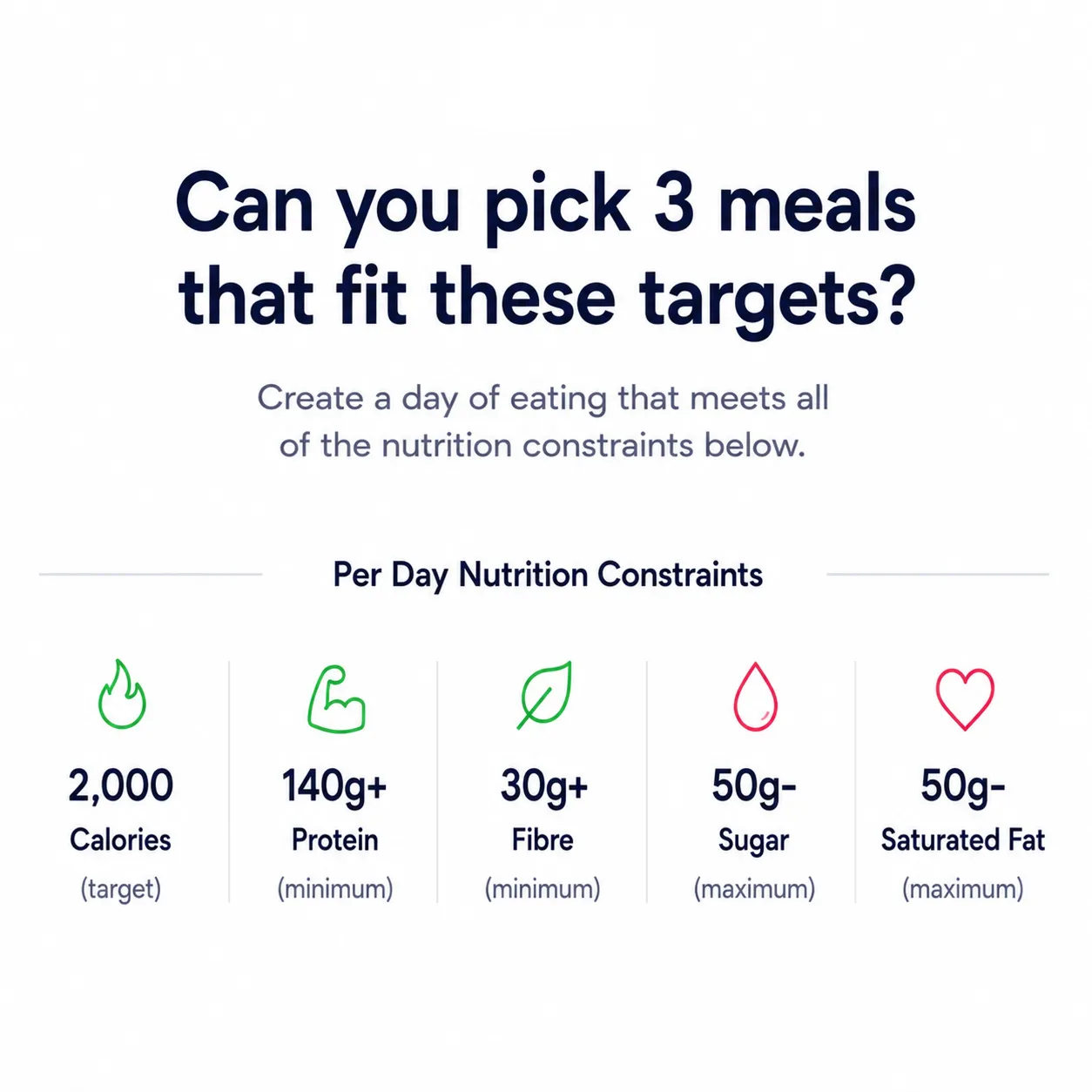
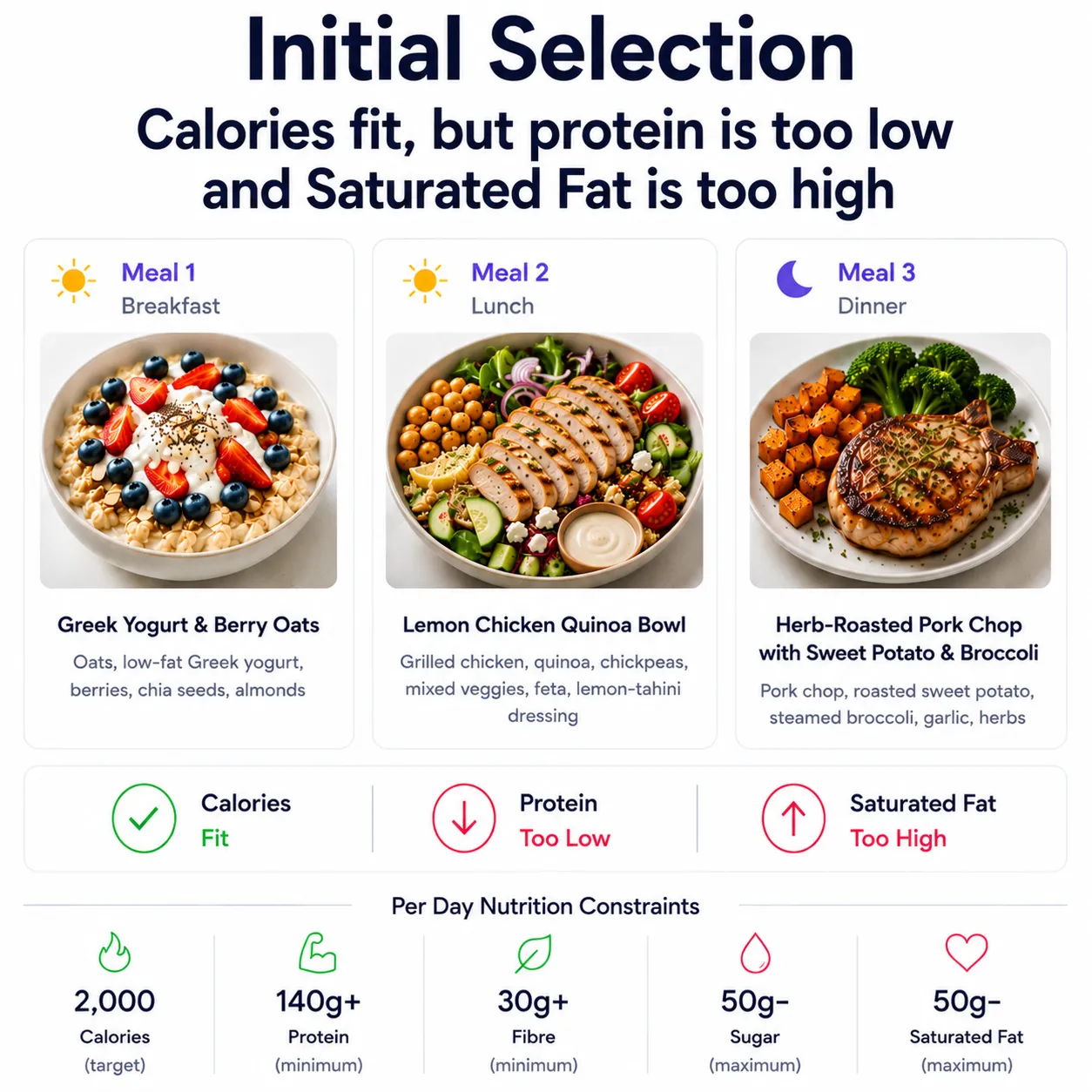
You choose three healthy meals. At first glance, they look like a great combination.
Then you check the day’s nutrition.
- ✅ Calories are on target.
- ❌ Protein is too low.
- ❌ Saturated fat is too high.
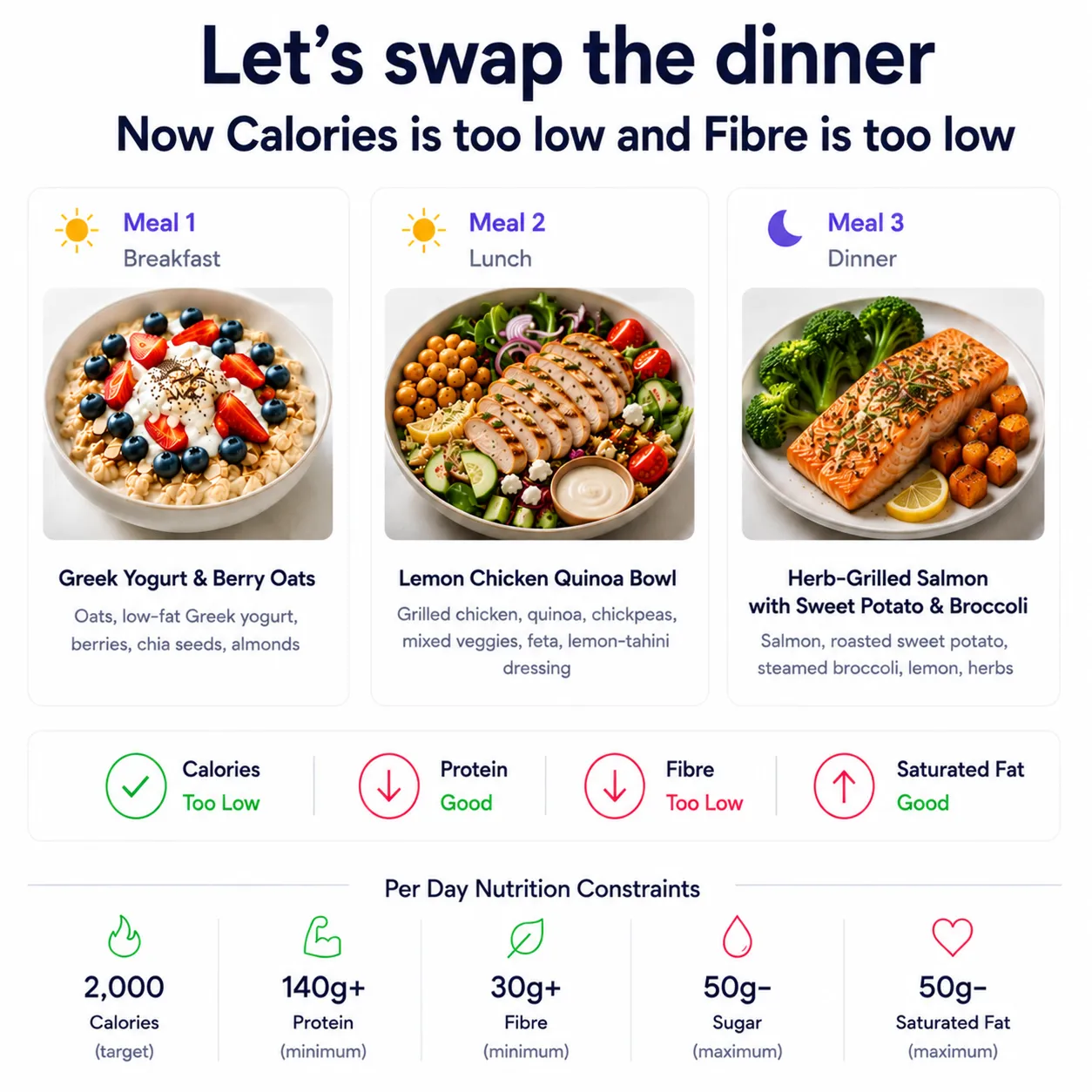
So you swap one meal. Now…
- ✅ Protein is fixed.
- ❌ Calories are now too low.
- ❌ Fibre is now too low.
So you swap another meal. Now…
- ✅ Fibre is fixed.
- ❌ Sugar is too high.
- ❌ Calories are too high.
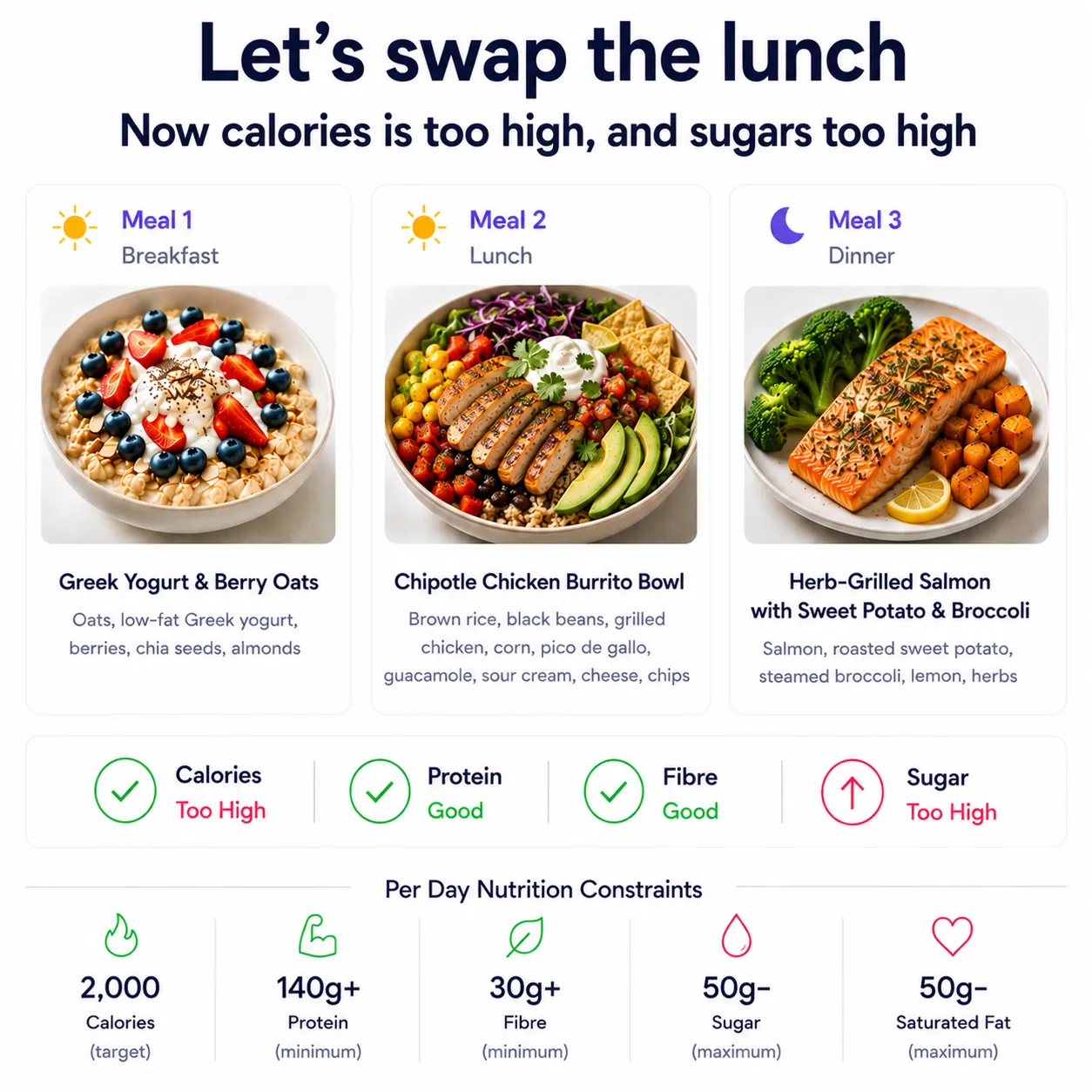
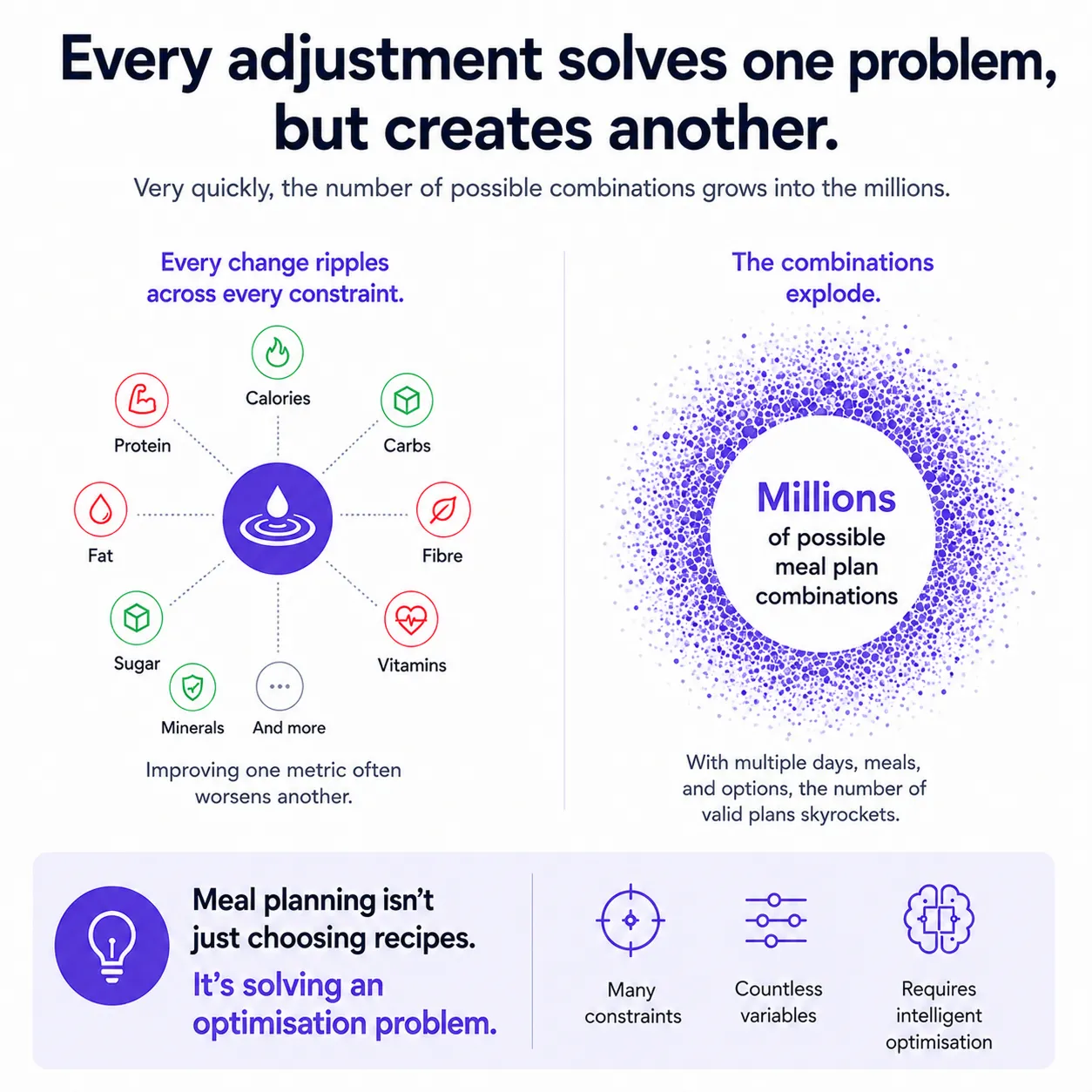
Swap again. One metric improves. Another moves out of range.
Soon you realise you aren’t choosing three recipes. You’re searching for the one combination of meals that satisfies every nutritional target, dietary restriction and personal preference simultaneously.
Every adjustment solves one problem while creating another.
Our Breakthrough
We realised we were asking the wrong question.
Instead of asking:
“Which recipe best fits these nutrition targets?”
We asked:
“What if we started with the ingredients instead of the recipe?”
That single shift changes everything.
Recipes are fixed.
Ingredients are flexible.
Rather than trying to force fixed recipes to satisfy changing nutritional targets, we begin with the nutritional outcome we want to achieve.
Our optimisation engine continuously explores millions of possible ingredient combinations, adjusting quantities and balancing meals until it finds a solution that satisfies an individual’s nutritional requirements while remaining realistic to cook and enjoyable to eat.
Advances in generative AI and optimisation techniques have finally made real-time personalised nutrition possible.
But AI isn’t solving the nutrition problem. It solves the culinary one.
Once the nutrition has been solved, generative AI transforms that solution into natural recipes, cooking instructions and beautifully presented meals. Our models are fine-tuned on thousands of real recipes, enabling them to learn culinary structure, ingredient relationships and cooking techniques while remaining grounded in nutritionally optimised outputs.
The result is fundamentally different.
Traditional systems start with recipes and hope they fit the nutrition.
We start with the ingredients, optimise the nutrition, and let the recipe emerge.
Why It Matters
For decades, personalised nutrition has been limited by one simple fact: creating accurate meal plans takes time.
Dietitians and nutritionists can produce highly personalised plans, but they cannot do it instantly or continuously for millions of people.
Traditional meal planning software scales, but only by simplifying the problem.
Real-time nutrition optimisation changes that.
For the first time, personalised dietary interventions can be delivered instantly, adapted continuously and scaled globally.
This opens the door to an entirely new generation of healthcare and wellness applications.
- Weight Management & GLP-1 Support – Adaptive nutrition programmes that evolve as patients progress.
- Diabetes & Metabolic Health – Meal plans optimised for blood glucose management and long-term metabolic health.
- Cardiovascular Health – Personalised nutrition for hypertension, cholesterol management and heart disease prevention.
- Gastrointestinal Health – Support for coeliac disease, IBS, low FODMAP diets and food intolerances.
- Cancer Care – Nutritional support before, during and after treatment.
- Kidney & Liver Disease – Meal plans that respect complex protein, sodium and electrolyte constraints.
- Women’s Health – Personalised nutrition for pregnancy, PCOS, menopause and fertility.
- Healthy Ageing – Optimising protein, fibre and micronutrients to support healthy ageing.
- Sports Performance – Nutrition tailored to performance, recovery and body composition goals.
- Preventive Healthcare & Diagnostics – Transforming biomarker testing and health assessments into continuously personalised nutrition programmes.
This is about far more than generating meal plans. It’s about creating the intelligence layer for personalised nutrition. A platform capable of powering healthcare providers, digital health companies, diagnostics platforms and AI health agents with nutritional interventions that are intelligent, adaptive and delivered at scale.
We believe this marks a fundamental shift in nutrition technology.